

Prime Minister Manmohan Singh said that rising food prices would make inflation control a more difficult task and it has the potential to derail economic reforms. "We in India too are deeply concerned about rising global commodity and food prices. . . a steep rise in food price will make inflation control more difficult and can thereby hurt the cause of macroeconomic stability. The constituency for economic reforms, so necessary for growth, would also diminish," the PM said.

The government is moving ahead slowly but steadily.

In the first phase of the Lok Sabha polls, there were 135 women candidates while in the second phase, there were 100 women candidates, bringing the combined total for the first two phases to 235 women candidates.

'Concerns about India's future are hampering private investment.' 'If the private sector sees strategy, teams and execution on these issues, this will inspire confidence in India.' 'This should be our main strategy for 2017,' says Ajay Shah.
OECD wants India to reduce trade and FDI barriers, and issue more banking licences.
The average rating was seven out of 10.
Top corporate managers on Thursday expressed confidence that the Congress-led coalition, in case it forms the government at the Centre, would give a fillip to economic reforms.

Making a case for reforms in the pension sector, the Economic Survey 2010-11 on Friday said the Parliament should expeditiously clear the long pending PFRDA Bill.

'Everything about farming is enjoyable and relaxing.'

'Over the next two quarters, markets will be guided by observing the earnings resilience of corporates during the second lockdown, progress of the monsoon and the damage, if any, to rural spending power due to the second wave.'
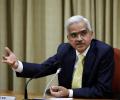
Reserve Bank Governor Shaktikanta Das on Wednesday said the country is at the doorstep of economic revival on the back of accommodative monetary and fiscal policies being pursued by the central bank and the government.

If Modi wants to leave a real legacy, breaking India's strategic triangulation would be the real gift, notes Shekhar Gupta.

'Three manufacturing sectors can create jobs by the million: Apparel, food, and electronic assembly.' 'Let's talk to them and ask them what it would take to scale by a factor of ten,' suggests Naushad Forbes.

'With China falling out of favour, India is where investors see the demographic and digital dividend apart from the benefits of reforms playing out.' 'Your prime minister has also done a great job of sharing this story with the world.'

FDI is a major driver of economic growth and a source of non-debt finance for the economic development of the country. The government has put in place an investor-friendly policy on FDI, under which investment up to 100 per cent is permitted on the automatic route in most sectors/ activities. At $ 64.37 billion, FDI in 2018-19 is the highest ever investment received for any financial year.
Reforms are key to India sustaining the pre-economic crisis growth rate of 9 per cent, United States Treasury Secretary Timothy Geithner said in New Delhi on Monday.
India's projected 8.1 per cent GDP growth rate this year was "quite achievable" as investors' confidence had gone up substantially due to sustained economic reforms, a noted economist said on Monday.

Pragmatism and flexibility is a virtue. An untethered and short-term approach to policymaking is a flaw, argues Mihir S Sharma.

The days of anti-reform, anti-growth advisers that undermined our economy in the UPA-II years will now be strictly behind us: Bhagwati

In her first address to a joint sitting of the two Houses in the new Parliament building in which she touched on varied issues ranging from insurgency to inflation, Murmu said a country can progress at a fast pace only when it defeats the challenges of the past and puts maximum energy into building the future.

The outcome is beyond the market's expectation and will be a sentimental boost, say analysts.

Prime Minister Narendra Modi has sought to send out the message that the ruling BJP, unlike its predecessors at the helm, is not guided by parochial politics in recognising contributions in the public life, as the party looks to break new ground during the polls.
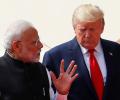
'While criticising India's high tariffs, Mr Trump stated he would impose reciprocal taxes on Indian products if re-elected.' 'However, since India's tariffs follow WTO rules, Mr Trump's actions would violate these rules,' Ajay Srivastava points out.

Benchmark equity indices Sensex and Nifty declined nearly 1 per cent on Wednesday, falling for the fourth day running amid profit-taking by cautious investors ahead of the results of the Lok Sabha polls. The 30-share BSE Sensex declined 667.55 points or 0.89 per cent to settle at 74,502.90. It went below the 75,000 mark to hit the day's low of 74,454.55, plunging 715.9 points or 0.95 per cent.

Nikkei 225 index hit the 40,000 mark for the first time ever on Monday, continuing its bull-run that saw the index reclaim its 1989 peak of 34,000 levels in February. as global investors latched on to Japan's biggest companies on improving shareholder returns, the weaker yen and booming corporate profits. Analysts remain bullish on Japan, mostly aided by gains in technology shares. Adoption of artificial intelligence (AI), according to a note by Morgan Stanley, is likely to benefit Japanese companies, which is almost at par with the US-based companies.

'Days ago, India witnessed the horror of the brutal rape and murder of a woman doctor on night duty at the R G Kar hospital in Kolkata.' 'The crime was so outrageous that any self-respecting chief minister should have resigned, bearing moral responsibility.' 'But then the terms 'self-respect' and 'moral responsibility' do not exist in the modern Indian political lexicon,' argues Vice Admiral Biswajit Dasgupta (retd).

More and more states are organising investor summits, Jaitley said.

India Inc on Thursday pitched for lowering income tax burden on common man, increase in capital expenditure, and firm steps to contain food inflation in their nearly two-hour long interaction with finance minister Nirmala Shitharaman ahead of the Union Budget. During pre-Budget consultation with Sitharaman, the industry leaders and associations also urged the government to focus more on infrastructure development with a view to maintaining the economic growth momentum. The industry leaders also laid stress on boosting the MSME (micro, small, and medium enterprises) sector, considered a backbone of the Indian economy and main employment generator.

'I hope that Macho Man agrees to debate her, because I think she will do spectacularly well in the debate.'

PM says FDI decision shows 'unwavering' commitment to reforms.

Chaudhary Charan Singh, who on Friday was conferred with India's highest civilian award Bharat Ratna, is popularly known as a champion of farmers.
Mamata Banerjee, a former United Progressive Alliance ally, said 'from petrol to onions, from diesel to dollar, from fertilisers to day to day expenses, prices are skyrocketing.'

'Maybe, India will never be reformed and maybe India will continue to have a quagmire for the rest of history.'
This columnist cannot pretend to be an economic expert but can certainly point out that the statistics being reeled out on a daily basis now, have added to the economic burden of the people, says Seema Mustafa.
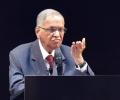
N R Narayana Murthy, co-founder of Information Technology giant Infosys, has lamented that economic activities in India were 'stalled' and decisions were not taken by the Manmohan Singh government in time in the Congress-led United Progressive Alliance-era.

A government that confuses PowerPoints for policy is delaying structural change too much.

'The Indian government is better prepared this time and has reached out to all contenders and not putting all eggs in one basket.'
UPA failed to undertake economic, social and administrative reforms to strengthen India's long-term development potential.
